Makana Fire Services has attended to 40 small to medium size veld fires during the past 12 months. Smoking, the burning of electrical wires to extract copper, and sparking overhead power cables are the likely causes of most. As Working on Fire warns of increased fire risk globally, SmilingSouth asked Makana Fire Services Manager William Welkom for local stats and advice.
Eight of the world’s worst wildfire weather years on record happened in the past decade, and that it will only get worse, according to Managing Director of Working on Fire (WoF), Trevor Abrahams.
“Climate and environmental changes are causing a global increase in wildfires, of which some have the propensity to become large scale disasters,” he said in a WoF media release this week.
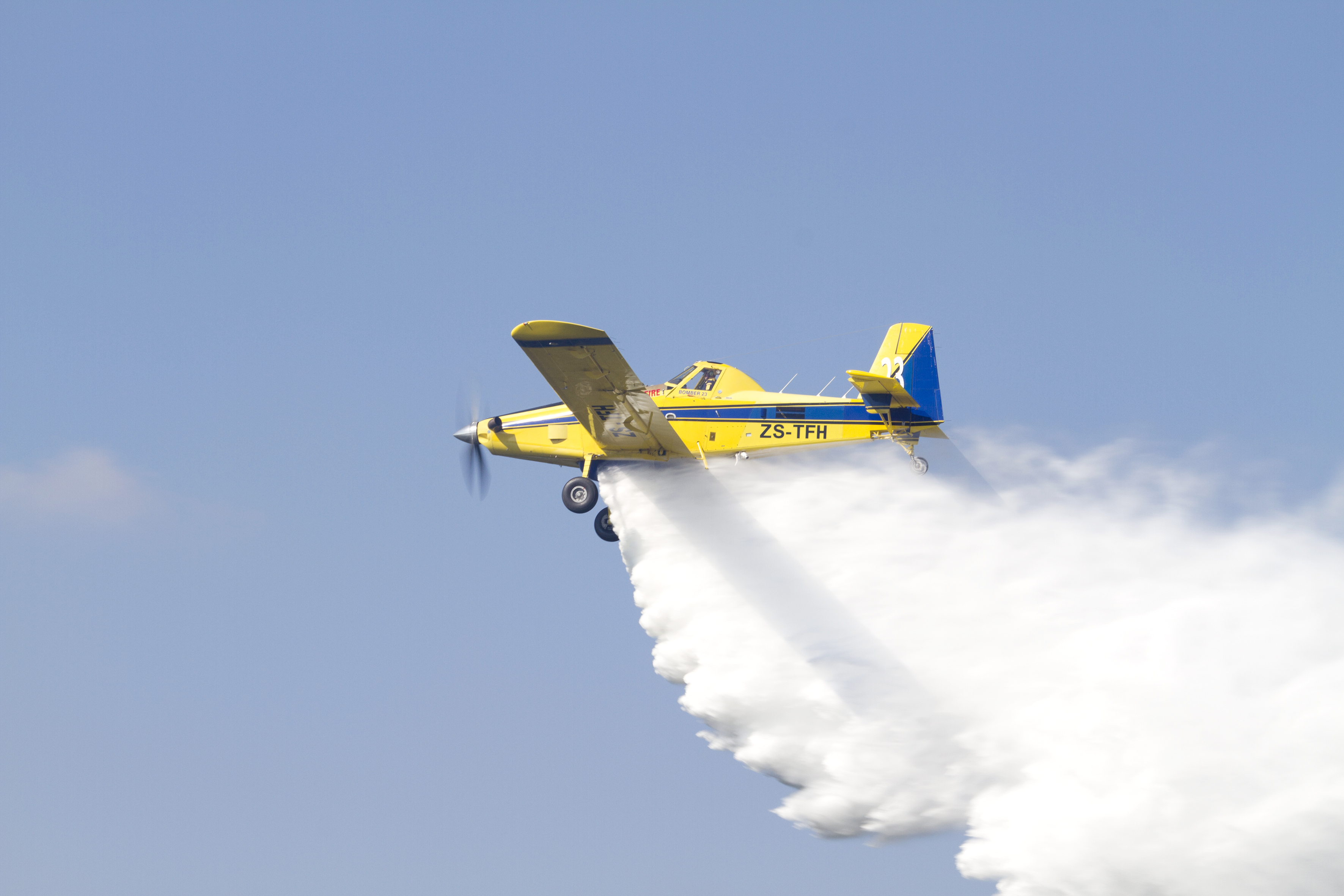
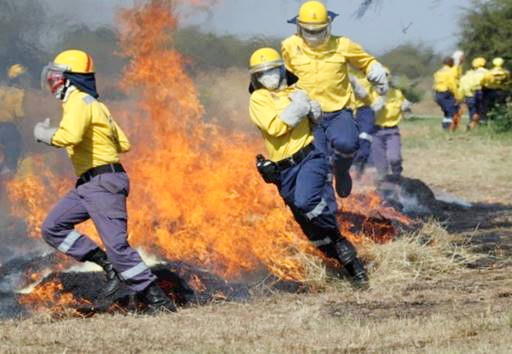
One of the tools to tackle this is the practice of integrated fire management (IFM), developed by Kishugu, Working on Fire’s implementing agent, Abrahams said. At a national level, this incorporates aircraft, vehicles, pilots, firefighters, incident management teams, equipment and tools.
But what kinds of resources are available to Makana’s fire fighting teams?
“Makana Fire Services falls under the Sarah Baartman East Fire Protection Association,” said Welkom. “Working on Fire has a base in Port Alfred and can be called upon to assist when required, through the Sarah Baartman District Municipality (SBDM) Disaster Management Centre.
“A contingency plan is also in place.”
Preventative measures to counter the start and spread of fire is core to Kishugu’s integrated fire management system.
Applying that locally, fire breaks are an important safeguard and Makana Fire Services advises land owners to create fire breaks around their properties.
“Controlled burning permits are issued to land owners,” Welkom said. To obtain a Controlled Burning Permit, land owners should contact Makana’s Fire Service Manager, or the Station Commander.
Makana has a winter fire season, from July to October.
The Department of Forestry, Fisheries and the Environment’s Working for Water programme has played an important role in reducing the risk of intense fires around Makhanda by clearing large numbers of invasive aliens from the surrounding hills. Pine and eucalyptus, in particular, burn easily and intensely.
“The Working for Water team is still active in Makana,” Welkom said.
Makana Fire Services has a direct link with Kishugu through the Port Alfred Working on Fire base.
The organisation provides integrated fire management services to government, environmental and military agencies, forestry and agricultural companies to land users, NGOs, national and multinational development agencies, industry associations and Fire Protection Associations (FPAs).
Quoted in a media release from Working on Fire, Kishugu CEO, Emile Grobbelaar, said, “Maintaining an 80% proactive focus takes planning, collaboration and dedication with all our partners in the provinces. Fires don’t respect cadastral boundaries, and IFM shouldn’t either.”
Kishugu and Working on Fire are frequently called to provide wildfire management capacity and skills in other parts of the world.
PREVENT FIRES IN MAKANA
Fire Services Manager William Welkom offers these tips for keeping your community safer from fires that start outdoors:
If you’re a land owner, make sure there’s a fire break around your property.
Don’t start unnecessary fires that can spread.
Burn household refuse in a metal container (drum) instead of in an open space, where a fire is more likely to spread, and always be aware of your surroundings.
If you notice a fire starting, please report it immediately to the Fire Department at (toll-free) 080 111 4444 or 046 622 4444.
Controlled Burning Permits are issued on application by the Fire Department – check daily weather conditions before starting a controlled burn and don’t do a controlled burn on a windy day.
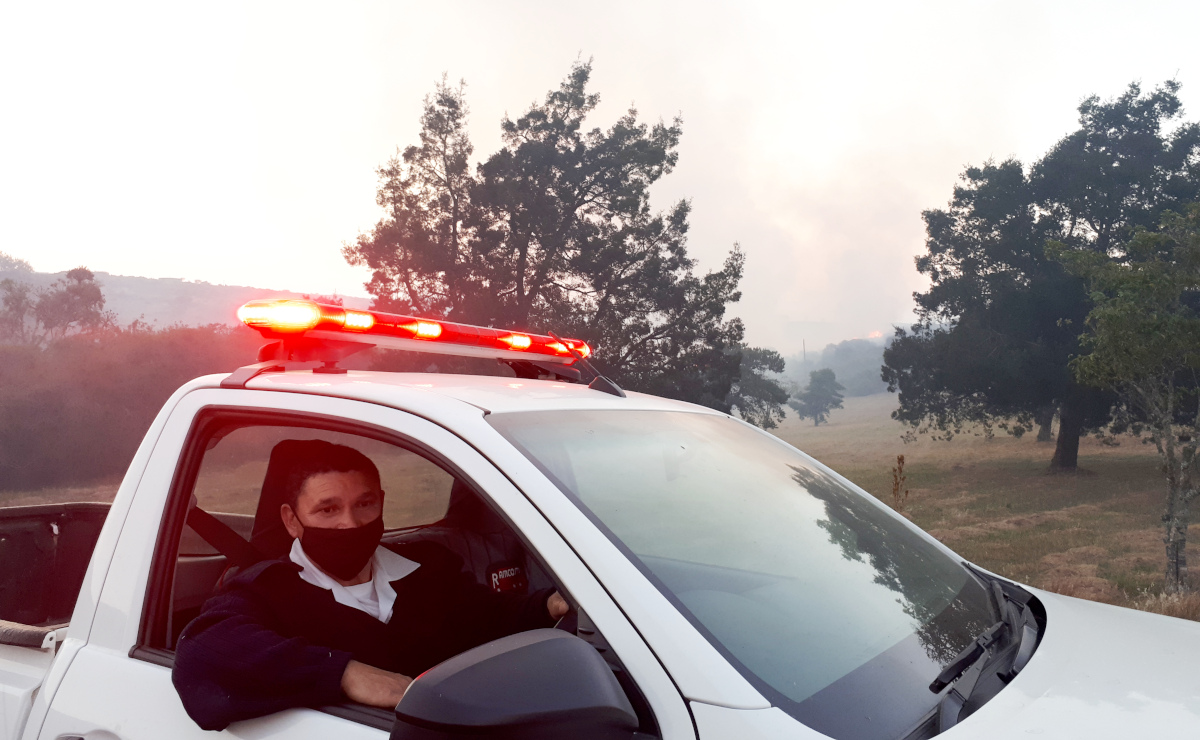
Makana Fire Services Manager William Welkom monitors a section of a fire approaching the Rhodes University Postgraduate VIllage in June 2021. Avoid making fires in open spaces, and report a fire as soon as you see it, he says. Photo (June 2021): Sue MaclennanKishugu’s aerial and ground fire fighting resources are available to Makana via the Sarah Baartman Disrict Disaster Control Centre and Working on Fire’s Port Alfred base. Photos supplied
With 48 432 people fully vaccinated for Covid-19 through its public and private health services, Makana remains well ahead of other Eastern Cape local municipalities and metros – at least percentage-wise. The statistics come as Rhodes University goes ahead with its policy that staff, students and service providers must be vaccinated to access the campus, and as Wits University Vaccinology Professor Shabir Madhi confirms that a turning point has been reached in the pandemic.
A total of 63 910 people must be vaccinated for the Makana municipal area to achieve its targeted coverage. According to the Department of Health, as of 1 March, Makana was 76% of the way to that coverage. Makana Municipality includes Makhanda, Alicedale, Riebeeck East, Salem, Seven Fountains and Fort Brown. Neighbouring Ndlambe, has achieved 31% coverage of its 54 473 target population to date.
The Sarah Baartman District as a whole has so far achieved a 46% vaccination rate. Closest to Makana percentage-wise is Nelson Mandela Bay Metro at 60% – but with a target population of 380 454, nearly six times bigger.
The numbers come from the Department of Health’s records as of 1 March 2022.
In October, the World Health Organization set a target for countries to vaccinate 70% of their populations by mid-2022. According to Covidvax.live 17 389 328 South Africans, or 28.96%, were fully vaccinated by 5 March 2022.
This week, Shabir Madhi, Professor of Vaccinology at University of the Witwatersrand and Director of the South Africa Medical Research Council Vaccines and Infectious Diseases Analytics Research Unit, says South Africa has reached a turning point in the pandemic.
The article published in The Conversation says new research on seroprevalence (Covid-19 antibody levels), hospitalization and excess deaths attributable to Covid-19, indicate that South Africa is moving into the recovery phase of the pandemic. In order to continue on this trajectory, Madhi says, vaccine coverage must be enhanced, primarily focusing on high-risk groups.
Earlier this week, an application for an urgent high court interdict to stop the implementation of Rhodes University’s mandatory Covid-19 vaccine policy was struck off the roll with costs.
Alarming reports, some of them informed by experienced technical sources, paint a picture of an imminent health and humanitarian disaster, with broken pumps, a shortage of treatment chemicals, an official’s removal of a crucial monitoring system and no public access to up-to-date water quality testing results. Makana has slammed some of the claims as ill-informed and says they could create unnecessary panic among the public. SmilingSouth independently asked expert sources to help judge how concerned we should be.
By Sue Maclennan
It sent shockwaves across South Africa when in 2019, the Gift of the Givers was welcomed by desperate Makhanda residents during a weeks-long water outage. Investigations by civil society activists and a councillor suggest the town’s 86 000-odd residents could be at risk of a water crisis at least as bad as any the town has survived in the past decade.
Monitoring by the DA and the Makana Residents Association has been reported on those organisations’ platforms during the past few weeks. The latest reports on Friday 18 February and Monday 21 February from councillor Geoff Embling and the Makana Residents Association say that:
Of seven pumps that should be rotating at Makhanda’s two water treatment facilities, only one is properly operational;
Both were set to run out of treatment chemicals by early next week (the water manager says these have arrived – please note the update on this below);
An official has had crucial water-level monitoring equipment removed from two stations;
With current water testing results yet to be made available, the community is in the dark about safety compliance.
How Makhanda’s water works
Makhanda has two water systems. Howieson’s Poort and Settlers dams depend on rainfall in catchments west of town. They serve the CBD and suburbs in west Makhanda via the Howieson’s Poort pump station and Waainek water treatment works.
The Orange-Fish River scheme feeds Glen Melville Dam. Pumping from there, the James Kleynhans Water Treatment works and pump station serve the east side of Makhanda, including its townships.
“It was alleged that one pump burned out due to the operator running the pump whilst the inlet valve was closed,” Embling wrote. The second pump’s impellor had broken when it was run during low water levels.
The remaining pump was in poor working condition, leaking water, Embling wrote. His sources estimated that Waainek currently receives about 70% of the 8 megalitres a day it requires from Howieson’s Poort pump station.
“If the remaining pump was to break, the Western half of town would be without any water at all…” Embling wrote on 18 February.
A transfer pipeline carrying water from James Kleynhans to west Makhanda should ensure the whole town receives water, even during drought. But it’s broken and hard-to-source parts are delaying its repair.
There were also fears about the integrity of the James Kleynhans system. Embling, informed by an experienced engineer, said James Kleynhans required four pumps, or at least three in rotation, to prevent overloading. Currently there were only two.
“Out of the two remaining pumps at James Kleynhans, one… keeps tripping and must be reset, so the pump station is largely reliant on one pump to deliver water from James Kleynhans to the eastern side of town,” Embling said. “It is disturbing that both… water supplies are basically running on one cylinder… it seems as if the two ‘lifelines’ to [Makhanda] are hanging by a thread.”
More than 86 000 residents would be affected should both fail at the same time, Embling said.
Embling described an incident at Waainek in December 2021.
“Poor flocculation and treatment [resulted in] in dirty water… [and] approximately 24 megalitres of treated water being released down the hill at Waainek. The wasted water had allegedly been treated with just over a ton of chemicals.”
Embling said a report in the recent Finance portfolio committee said Makana’s supplier of water treatment chemicals had been paid close to R200 000, but had not delivered. The municipality had issued them with a letter of non-compliance and (at the time) there were less than two weeks’ worth of treatment chemicals left.
“The public needs to be informed about the situation,” Embling said.
The concern came as the Chris Hani District Municipality has become the latest public entity to advise residents to boil tap water due to poor quality. Nelson Mandela Bay metro has now declared their water safe to drink following diarrhoea and vomiting outbreaks and the death of a child allegedly linked to dirty water. Buffalo City Metro Municipality’s boil water advisory still maintains.
A 21 February letter from the Makana Residents Association to its members echoed Embling’s warnings and said it was a concern that the only person with access to the municipality’s high-tech monitoring system, SCADA, was the municipality’s water manager. Two other monitoring terminals had been removed from their stations at a local engineering company, and Rhodes University.
Continuing outages
Meanwhile, on the ground, residents and businesses continue to experience outages – in some cases for longer than two weeks at a time. The regime of providing water on alternate days is intended to allow all the town’s reservoirs to fill, so there can be equitable distribution from the gravity fed system. However, residents have frequently reported no water, or an early cut-off on days when they are due to have water.
A break in the transfer line from James Kleynhans and the Worcester Street engineering nightmare, along with numerous pressure-related pipe breaks across the town, have brought about several outages since the beginning of the year, in some areas as long as two weeks at a time. Most recently, a large release of water for downrtream users into the Fish River system that serves James Kleynhans resulted in high turbidity there, with challenges for treatment and therefore supply.
Some residents in Fitzroy Street have had no water at all in their taps for over two weeks.
“I can’t remember the exact date our water went out,” one resident told SmilingSouth. “But it’s been over two weeks now that we’ve had no water. “Our tanks are almost dry now and there is no rain.”
Fitzroy Street is the site of a project to replace old asbestos pipes. Completion of the project was hampered by the theft two weeks ago of several (metal) connecting valves.
On neighbourhood WhatsApp groups across the town, residents and business owners frequently report taps running dry early on “water on” days.
By Friday 25 February, residents in Emacangcini near JD Dlephu Stadium – served by the James Kleynhans system – reported having had no water for three days.
Makana’s Communications team posts updates daily. These sometimes include warnings of additional outages for maintenance or repairs; however, some outages aren’t explained and residents continue to vent their frustration at this on social media.
‘Misinformed perspectives’
Responding to questions based on the reports, Makana Municipality has hit back at the monitoring visits.
“Unauthorised visits without relevant escorts are not allowed, as they tend to provide misinformed perspectives,” the municipality said via its communications department.
The response from Makana Municipality to this reporter’s questions is included in full below. Some of the responses raise further questions. For example, Makana says of the Howieson’s Poort Pump Station that the municipality has submitted business plans to potential funders for its refurbishment, including the purchase of a full pumpset.
Amatola Water, which managed Makana’s bulk water supply from 2013 to 2017, completely refurbished the Howieson’s Poort pump station at a cost of R2 116 804.77. This included repairing motors 1 and 2 at Howieson’s Poort pump station; completely refurbishing a third pump; upgrading the pump control panels and installing instrument control devices, among other upgrades and repairs. This information is contained in the organisation’s close-out reports. In presentations to the municipality and residents at the time (2017), as well as earlier interviews with this reporter, Amatola Water explained that new pump and motor were specifically built to ensure that there was sufficient spare capacity to minimise the risk if there was catastrophic failure of pump sets 1 or 2. This was done due to the very long lead times to have those big motors and pumps repaired (around six months).
At the time, it cost around R500 000 to refurbish one of the Howieson’s Poort pumps. A single impeller blade took a week to be precision-engineered by the supplier.
It was for these reasons that protection mechanisms were built into a brand new control panel at the facility. A Programmable Logic Controller, it’s designed to receive data from the operating components (the pump systems) and in turn send operating instructions (such as to shut down the pump if it’s overheating).
Makana’s responses (as of 22 February at 8pm)
Water treatment chemicals
Makana Municipality (MM): The available chemical is sufficient to take us to Thursday, 24/02, when the next batch is delivered. There is a general shortage of water treatment chemicals, due to scarcity of raw materials nationwide (see http://ws.dwa.gov.za/IRIS/notice.aspx), and this is not unique to Makana Municipality.
UPDATE ON 25 FEBRUARY 2022 Makana’s Water Manager Gubevu Maduna Friday morning 25 February told this reporter that water treatment chemicals for the two waterworks had been delivered on Wednesday 23 February – a day earlier than scheduled. “We also have backup stocks, so it was not going to be a problem,” he said.
‘Burnt out’ pump at Howieson’s Poort
MM: The matter was reported and investigated but could not be proven. However, the municipality will gladly accept any further information that the community can assist with.
Second broken pump at Howieson’s Poort
MM: When the level of the dam is low, water quality deteriorates… high amounts of suspended solids [cause] excessive throttling on the sleeves… the impellers get stuck in the neck ring…”
NOTE FROM A SOURCE WITH KNOWLEDGE OF THE SYSTEM: For either of these catastrophic events to occur, either the PLC was not working, or it was bypassed. The software is designed to make the pumps shut down before an event such as cavitation or overheating.
Remaining pump at Howieson’s Poort
MM: The remaining Pump at H/Poort is designed to pump 131l/s, translating to 11,3Ml/day, which is more than enough for the design capacity of Waainek Water Treatment Works, hence the excess amount of water pumped, but not treated is stored in the lei dams. The pump was repaired in June 2021… [it] is currently working and not in need of repairs. The pump is designed to have a circulation of cooling water and wet gland packings, for its normal operations. This may be viewed as a leak, from a layman’s point of view, hence unauthorised visits without relevant escorts are not allowed, as they tend to provide misinformed perspectives.
NOTE FROM EXPERIENCED ENGINEERS OUTSIDE THE MUNICIPALITY Source 1: The response from muni is correct in that pumps have packing glands (kind of bearings) that are kept moist with water from the pump – it is not usually a lot of water (a trickle) so if it appeared to be a leak there could be a problem.
Unfortunately the municipality has responded according to some of the details and not addressed the most serious issues: Howieson’s Poort has only one pump which has to operate 24/7 in order to supply water for west of town while the transfer pipe is damaged.For an official to have the opinion that only one pump is necessary at Howieson’s is indicative of bad practice being taken as acceptable.
Source 2: Yes it’s correct that water pipes fixed to each pumpset are meant to drip at a certain rate to cool down the bearings. Howiesons Poort requires three pumps: one duty pump, one standby pump and one cold standby pump. These must be alternated to allow for maintenance.
These sources, with whom this reporter communicated directly, asked to remain anonymous.
James Kleynhans pumps
MM: JKWTW has a design capacity of 10Ml/day and the Treatment works delivers and pumps from the Treatment Works to the Reservoirs an average 11.5Ml/day which is only achievable with 2 working Pumps. So, it is incorrect to claim that only 1 pump in JKWTW is effectively working. The pumps are designed to cut off when the clear water well is at minimum level, which may be viewed as tripping by a non-expert. This is a protection mechanism that is designed to minimise catastrophic damage that could occur should the pump run without enough water in the suction head. Once again, this is an ill-informed view, which creates unnecessary panic [among] the public.
NOTE FROM AN EXPERIENCED ENGINEER OUTSIDE THE MUNICIPALITY If the pumps are stopping due to an empty intake tank that is normal – but if the pumps were tripping (due to a fault such as overheating) that is a different matter. JKWTW with only two pumps is also operating at full capacity without provision for standby and maintenance. This is bad and very risky procedure. There is a reason that these pump stations have been designed by engineers with respectively three and four pumpsets. Emphasis should be on these bigger issues without the Municipality answering only some of the technicalities.
This source, with whom this reporter communicated directly, asked to remain anonymous.
What is the plan if the single operational pump at one or other (or both) treatment plant(s) breaks down?
MM: JKWTW: All 4 pumps are at the plant… However, what is missing, are the 2 motors, to have 4 complete pumpsets. 3 motors went for repairs and are ready to be delivered and installed.
MM: HOWIESON’S POORT: The 2 pumps went for strip and quote, however, due to the associated costs, it was viewed uneconomical to repair than replacing. The Municipality is in constant talks with the Service Providers, to establish various options that could be most economically viable and beneficial to the Municipality. On the other hand, the municipality had submitted Business Plans to potential funders for the refurbishment of the pumpstation which also includes a purchasing of a full pumpset.
24 million litres of treated water wasted in December 2021
MM: The total coagulant used for the month of December was 900 litres (1035kg) to treat 69.7ML. 60% of this water was further treated with [disinfectant] before [entering] the reservoir. The remaining 40% had to be released into the stream that flows back to Howieson’s Poort Dam, as it was not fit for human consumption. This had nothing to do with the incorrect methods, but rather a situation resulting from an abnormal raw water turbidity, for the available coagulant normally used at Waainek WTW. The plant is usually operated with a low-turbidity range coagulant… raw water turbidity is normally below 40NTU. As a result of the flash floods in December, the turbidity of the raw water spiked up to more than 1000NTU.
SCADA system monitoring panels removed
MM: The SCADA is an operational system that helps the operators to monitor and manage the water value chain. The current operator of the Makana Water System is Makana Water Department which is managed by Mr Gubevu Maduna… This is a vulnerable system that requires restricted access for control purposes and accountability, hence it cannot be co-managed and accessible to everyone.
Water quality testing results
MM: Samples were taken and the results are available, however cannot without being uploaded on DWS’s IRIS system… Once uploaded, they will be made available to you.
UPDATE ON FRIDAY 25 February 25, 2022 Water Manager Gubevu Maduna said the results had been uploaded on IRIS and were available via the Infrastructure Director. This reporter has requested a copy from the Director.
UPDATE: THESE WERE RECEIVED ON 1 MARCH 2022 (SEE BELOW)
Parliament’s Portfolio Committee on Water and Sanitation conducted a site inspection at Makhanda’s James Kleynhans Water Treatment Works (JKWTW) on Tuesday 25 January 2022. DWS spokesperson Sputnik Ratau said the visit to the Department of Water and Sanitation-funded upgrade project was to assess progress. Following numerous delays since the project started 10 years ago, the most recent revised anticipated completion date was March 2022. The upgrade is set to double the facility’s production to 20 megalitres a day.
For the past month, it’s been the town’s water reticulation rather than supply issues that has caused prolonged outages. But there have been questions about supply as well.
With too little rainfall in its catchment, Makhanda’s main reservoir, Settlers Dam, remains depleted. The R10 million refurbishment of Jameson and Milner Dam has yet to add to the water supply west of the town. However, recent photographs show Howisons Poort Dam to be full.
For a brief period in 2021, with Howisons at 75% and feeding the Waainek Water Treatment Works, the town received water every day. So residents have been puzzled to see in communication from the municipality that the reservoirs that are filled by Waainek (via Howisons Poort) are low.
In response to questions from SmilingSouth, Makana said, “Howisons Poort is currently utilised for Waainek; however it is currently operating at 60% capacity, in order to manage turbidity levels to be always below 1NTU [the unit used to measure the concentration of suspended solids in water].
“Also, the water on the western side of town is usually a mix from both Waainek and JKWTW,” the municipality’s infrastructure directorate said via Makana spokesperson Yoliswa Ramokolo.
This was because while the combined water storage capacity for west Makhanda is 13.52ML a day, Waainek’s design capacity (how much water a day it can treat) is 8ML.
The month-long outage in several parts of town was caused by problems with reticulation. A project to replace sections of this very old, mostly asbestos pipe system began last year and is still under way. MANCO, the contractors for that project, were the ones called to assist the municipal team to fix the long-running Worcester Street saga.
Burst pipes
The crucial Worcester Street pipe junction in Makhanda that repeatedly defied repair was finally fixed on 26 January. The conclusion to the engineering nightmare came after four weeks of repeated pipe bursts there and across the town left many residents with dry taps and short tempers. Makana Municipality was able to reinstate the town’s normal one-day-on, one-day-off regime, a day after Parliament arrived in town to inspect its main water treatment works and a day before councillors heard that water losses had amounted to R7.9 million in the previous financial year.
Responding to questions about multiple repeated burst pipes across Makhanda during the past month, Makana said the aged and dilapidated infrastructure; excessive pressure, when sections are isolated; and damage to the reticulation system during construction because the as-built drawings are often not accurate, were the main contributing factors.
Hard-to-get parts, rain filling up the repair trench, a TLB (“digger”) breaking down, further leaks filling up the repair trench with water and the repair team having to urgently attend to new serious pipe breaks across the town were some of the challenges the Makana team faced.
It wasn’t the first time that the combination of rain, clay ground and the ageing water system caused chaos at the Worcester Street site. In April 2018, local newspaper Grocott’s Mail reported on an operation to rescue a cow that fell in the water-filled trench after protracted repairs there.
Professional service provider
But questions have been asked about the qualifications and experience of those tasked with contracts and repairs, and those overseeing the town’s water systems.
Not knowing the [reticulation] system properly and not opening and closing valves in the correct sequence when turning the water on and off, may have contributed to the repeated breaks, a person familiar with the town’s decades-old water systems said. “Also failure to properly compress the pipe after fixing it. There is a lot of pressure in the pipes when you switch the water back on and if sand has just been thrown on top and not compressed, it will burst in the same place,” they offered.
Asked about the competence of those tasked with maintaining and repairing the town’s water systems, Makana responded, “The plumbing team and supervisors have the necessary qualifications, skills and expertise, at various levels, based on their job description. There is also a Professional Service Provider and a contractor with relevant CIDB grading, who is contracted for the replacement of the old asbestos pipes.”
Director of the Public Service Accountability Monitor (PSAM) at Rhodes University, Jay Kruuse, called on the Mayor and Municipal Manager to publicly release the approved organogram of Makana Local Municipality.
“This should include a breakdown of which posts are filled by whom and which posts remain vacant,” Kruuse said. “The public has a right to know the extent of vacancies and who in fact occupies which posts in the municipality, so that accountability mechanisms can be strengthened.”
Kruuse said the repeated and widespread water outages across Makana Municipality continued to violate the constitutional right of access to sufficient water.
“PSAM also calls on municipal councillors elected recently to interrogate the organogram and to take oversight action to address deficiencies that continue to impact negatively on the operations of the municipality.”
Critical upgrade
Parliament’s action-oriented visit to James Kleynhans Water Treatment Works last week was not in response to the month-long water outage in parts of Makhanda, but in order to do oversight on the critical upgrade to the facility that will ultimately ease the city’s supply problems.
DWS spokesperson Sputnik Ratau said MPs accompanying chairperson of the water and sanitation portfolio committee Robert Mashego were the committee’s Whip, Grace Tseke, Nancy Sihlwayi and Mogamad Hendricks. The DWS Eastern Cape team was led by the Provincial Head Portia Makhanya, Amatola Water chairperson Dr Mosidi Makgae and acting CEO Sazile Qweleka.
“This was an oversight visit by the Parliamentary Portfolio Committee on Water and Sanitation on DWS funded projects to assess progress made,” Ratau said. Other Eastern Cape projects they visited were Ngqamakhwe Bulk Water Supply; Xhora Bulk Water Supply; Mzimvubu Water Project at Maclear’s Siqhuqwini village (oversight visit for the access road to the dam wall); King Sabata Dalindyebo Presidential Intervention Bulk Water Supply Project; Ndlambe Emergency Bulk Supply Project and the Nooitgedagt Phase 3 Bulk Water Supply.
It was too early to comment on the Committee’s findings.
“The Committee will convene and discuss their observations and make recommendations and can release these as the Committee sees fit,” Ratau said. “The report will be compiled and processed according to the rules of Parliament.”
Meanwhile, in local government, Makana’s internal audit committee report tabled at last week’s council meeting revealed that water losses amounted to R7.9 million in the previous financial year.
“There is a high percentage of losses and revenue collection is slow,” said audit committee chairperson Professor Wesley Plaatjies.
“The cost of not implementing controls to reduce these losses versus the cost of repair and implementing controls over the long term need to be considered,” Plaatjies said. “The committee requested a fully costed report implementing loss controls for the next audit committee meeting.”
Settlers Dam from the waterfront area of the campsite at the end of November 2021. Rainfall in the catchment up to the end of January 2022 has failed to bring Makhanda’s main reservoir anywhere close to the level required before it;’s possible to extract water. Photo: Sue Maclennan
When an inter-town passenger bus drove into and snapped a low-hanging electric cable in George Street early on 23 January, residents asked why it seemed to have been ignored, more than three hours after it was reported. Makana Municipality said their electricians had been there, but a changed padlock meant they weren’t able to access a substation so they could safely work on the fault.
A little after 5.30am on Sunday 23 January, Sunnyside resident Cathy Gorham (who gave permission for these posts by her to be used) put a warning on the Sunnyside neighbourhood WhatsApp group.
“Wire quite possibly live hanging very low across George Street. Wire runs along Lawrence so crosses the intersection there. [Local security company] has reported it. Looks low enough for a truck or bus to run into. Be careful.”
Seconds later, she posted: “Anyone else without electricity??”
Then almost immediately: “Intercape bus drove into this wire hanging over George Street.”
Gorham said she’d been leaving home to take her dogs for a walk. When she reached a tree on the corner, she looked up and noticed the low-hanging wire. Worried that it could hurt someone, she quickly went inside to report it to a local security company and warn her neighbours.
When Gorham went back outside, she was shocked to see that exactly what she’d predicted had just happened: an Intercape bus had come to a halt after driving into the cable and snapping it.
The force of the rebound had cracked a left side window of the bus and the driver was walking around the vehicle checking for further damage.
Gorham was horrified to see that the other end of the now broken cable had ended up exactly where she’d been standing with her dogs a few minutes earlier.
“If I’d left my house two minutes later with my dogs, one of the cables that snapped… would have hit me,” Gorham said. “It wrapped itself around the tree on the corner [i.e. the one she’d been standing next to].”
Another resident said the low-hanging cable had been reported to the municipality much earlier, to no avail.
Just over an hour later, Gorham reported that municipal electricians had arrived to work on the fallen lines.
Intercape Communication Officer Shaun Smeda confirmed that the incident did take place around 5.50am on the morning of 23 January 2022.
“No passengers or crew were injured,” said Smeda, who declined to comment further.
Makana Municipality said their standby electrician had received a call from the fire station at 2.10am about a power outage in George Street.
“He went to pick up the standby team, and arrived at 03:10,” spokesperson Yoliswa Ramokolo said. “The team noticed a low-hanging aluminium conductor [at the intersection of] George and Lawrence streets.
Gusts of wind were blowing it towards the branches of a tree.
“When tested, it was discovered that the conductors were not live,” said Ramokolo.
The electrician organised a standby cherry picker team, who arrived at 4.30am.
“Both teams went to the Market [Square Centre] substation (at the back of Shoprite) where George and Lawrence streets are powered [from]; however, they could not get access to the substation, as the padlock [had been] changed…”.
“While still waiting for security, who arrived at 06:00, to open the substation for full isolation, the team received a call from the fire station, notifying them about the incident that involved the bus, which snapped off the low-hanging conductor,” said Ramokolo. “So, the main delay was a result of inaccessibility to the substation.”
Market Square Centre is managed by Broll Property and SmilingSouth spoke to the company’s asset manager for the Eastern Cape, Izak Kriel.
Kriel said, “There has been no instruction from me to provide or change a lock for that substation.”
Asked what the response protocol is for faults involving electrical infrastructure, Ramokolo said, “Faults are reported at the electricity department during the day and at the Fire Department after hours and then a standby electrician will be contacted.”
We asked: what does the maintenance programme for electrical infrastructure in Makhanda entail and how is the infrastructure checked for safety and integrity?
Makana responded: “The departmental maintenance programme entails substation inspections and overhead line inspections. These are checked through relevant testing equipment and captured on the relevant inspection sheets.”
Council’s portfolio committee for infrastructure has oversight of maintenance programmes through the inclusion of inspection records in its meeting agendas.
Have a say
Residents can play an effective role in highlighting neighbourhood issues through ward committees and Makana’s ward committee elections are coming up so ask your ward councillor for nomination forms. Think about people in your community who you think will make sure your concerns are heard and who can provide your ward councillor with the detailed information they need to fully represent your interests and help solve neighbourhood issues.
The side window of an inter-city passenger bus was broken when it drove into a low-hanging electric cable as it entered Makhanda early on Sunday 23 January 2022. Photo: Cathy Gorham
Members of the Department of Health’s Makana Subdistrict team with the VW Vaxxers (front row from left) Mnikezeli Fatman; Khanya Soci, Nontozinhle Hewana, Colleen Maqoko; (back row from left) Hayley Davids, Nonkqubela Monakali, Elize Williams and Nomawethu Ndukwana. Behind Ndukwana is Subdistrict head, Mohamed Docrat. Note: masks removed briefly for the photograph only. Photo: Steven Lang
It’s going to be easier than ever for residents and holidaymakers in and around Port Alfred and Makhanda to get up to date with their Covid vaccinations this festive season. The Department of Health’s VW Vaxxers are about to hit town at pop-up sites from Bushmans to Bathurst, Alexandria to Alicedale as they push this corner of the Eastern Cape closer to the 70% vaccination rate scientists say we need to get the better of the pandemic.
Four additional vaccinators and a data capturer have been brought in to boost the Department of Health’s Makana Subdistrict vaccinators over the next three months. The team will be setting up and operating pop-up vaccination sites throughout this period. Three VW Vaxxers will be based in Makana Municipality and one will work with a team in Ndlambe.
“We want to make it as easy as possible for people to get vaccinated,” said Subdistrict head of health, Mohamed Docrat. “The plan is to go to where people are, so they don’t have to interrupt what they’re doing, or make complicated plans to get to a vaccination site.”
Shopping centres, taverns and other popular spots are where you can expect to see them and while it’s helpful if you pre-register on the EVDS (electronic vaccination data system), you can also register at the pop-up.
While anyone eligible to be vaccinated is welcome at the pop-up sites (as well as the permanent sites), the team will particularly be targeting younger people. Latest available vaccination stats for the area show that the lowest vaccination rate is among the 18-34 age group. Just over half of 23 874 people targeted in that age group are fully vaccinated.
In order to stabilize infections and serious illness, the national Department of Health is aiming for a 70% vaccination rate. In September 2021, Deputy President David Mabuza said the country was on track to vaccinate 70% of South Africans before the end of the year. However, the covidvaxlive vaccination tracker reports that on 8 December 2021, 25.46% of the country’s population is fully vaccinated.
The Makana municipal area has somewhat bucked the national trend.
Vaccination targets refer to 70% of the population within an age group. For Makana, the 50-59 and 60-plus age groups reflect a 105% fully vaccinated population – an anomaly caused partly by the fact that vaccinations are recorded according to where a vaccine comes from. In other words, if a team from Makana conducts a community outreach campaign in Alexandria using vaccines from the Settlers Hospital supply, the vaccinations will be recorded for Makana.
The 34-49 age groups reflects a respectable 84% fully vaccinated rate in Makana.
The 18-34 group is at 54% and so it’s this group that will be the main focus of the campaign.
Meanwhile, while many are yet to receive their first shot, the South African Health Products Authority (SAHPRA) on Wednesday approved the distribution of the third dose of the Pfizer COVID-19 vaccine for adults. This means all adults in South Africa are now eligible for a booster shot six months after the second dose. SAPHRA says Pfizer booster shots will available from January 2022.
According to Pfizer and BioNtech, three doses of the Pfizer-BioNTech COVID-19 Vaccine neutralise the Omicron variant (B.1.1.529 lineage). Omicron is a fast-spreading variant first identified by South African scientists.
Members of the Department of Health’s Makana Subdistrict team with the VW Vaxxers (front row from left) Khanya Soci, Elize Williams, Colleen Maqoko, Nomawethu Ndukwana, Nontozinhle Hewana; (behind, left to right) Mohamed Docrat, Mnikezeli Fatman, Nonkqubela Monakali, Magdalene Assumption, Pumla Hermans, Marilyn Haywood, Hayley Davids, Gudrun Langford, Noel Isaacs. Photo: Steven Lang
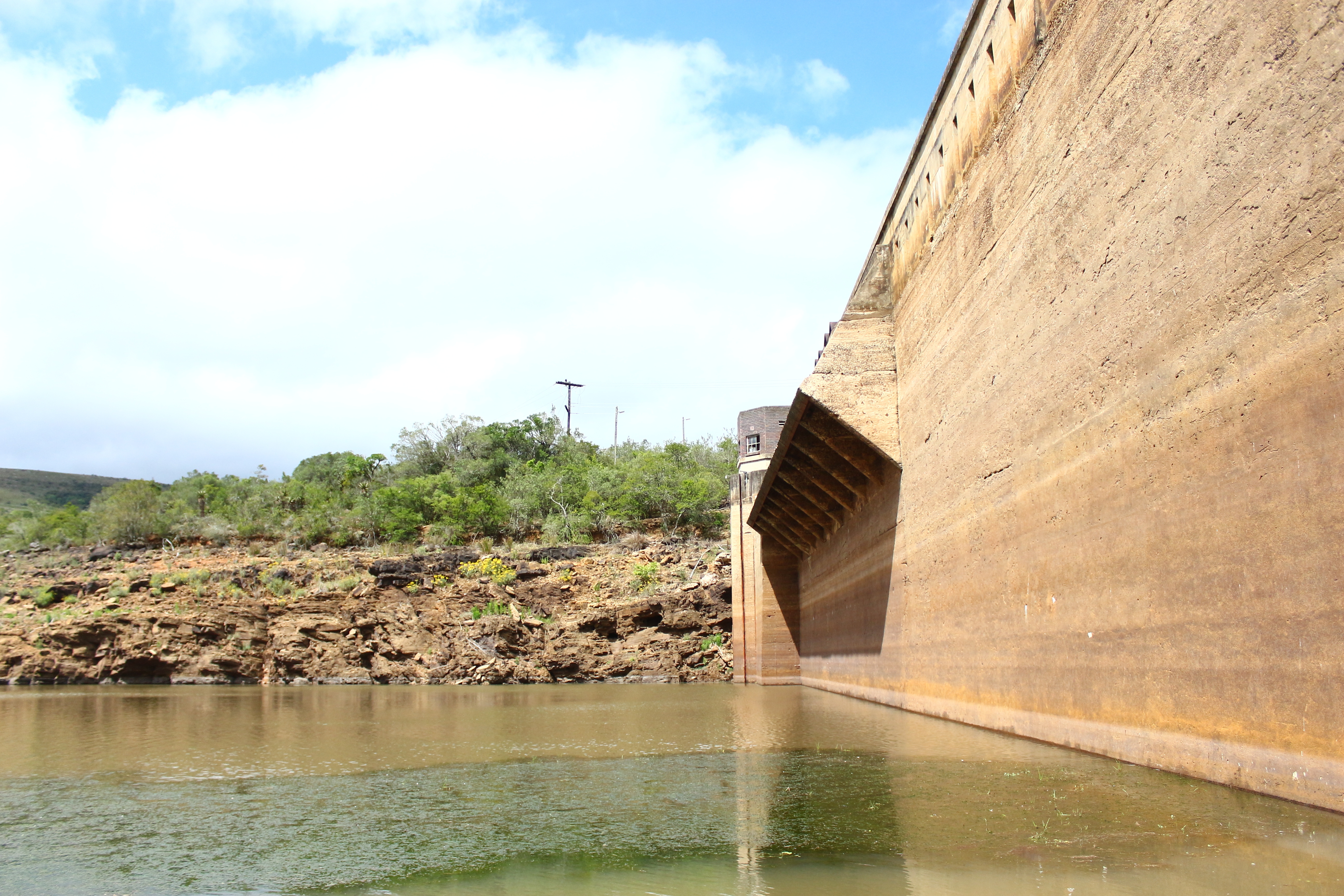
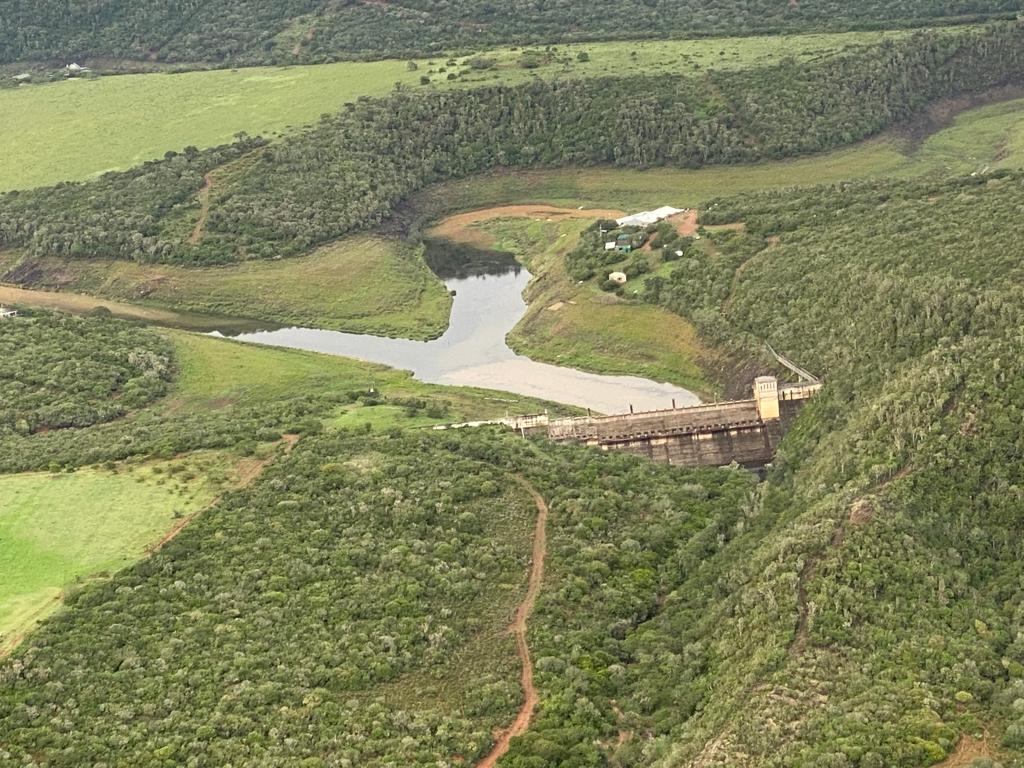
Howieson’s Poort Dam on Monday 7 December. Howieson’s, which is much smaller than Settlers, Makhanda’s main western supply dam, is currently at 75%. Photo: Lynda Brotherton
Farmers celebrate rainfall – but the drought’s not over
By Sue Maclennan
With close to 60mm measured in and around Makhanda during the past three days, residents have asked whether the drought (and with it, some of the town’s water problems) may be over. Sunday’s downpour added to the rains of recent weeks made a difference – but the town is still short of water.
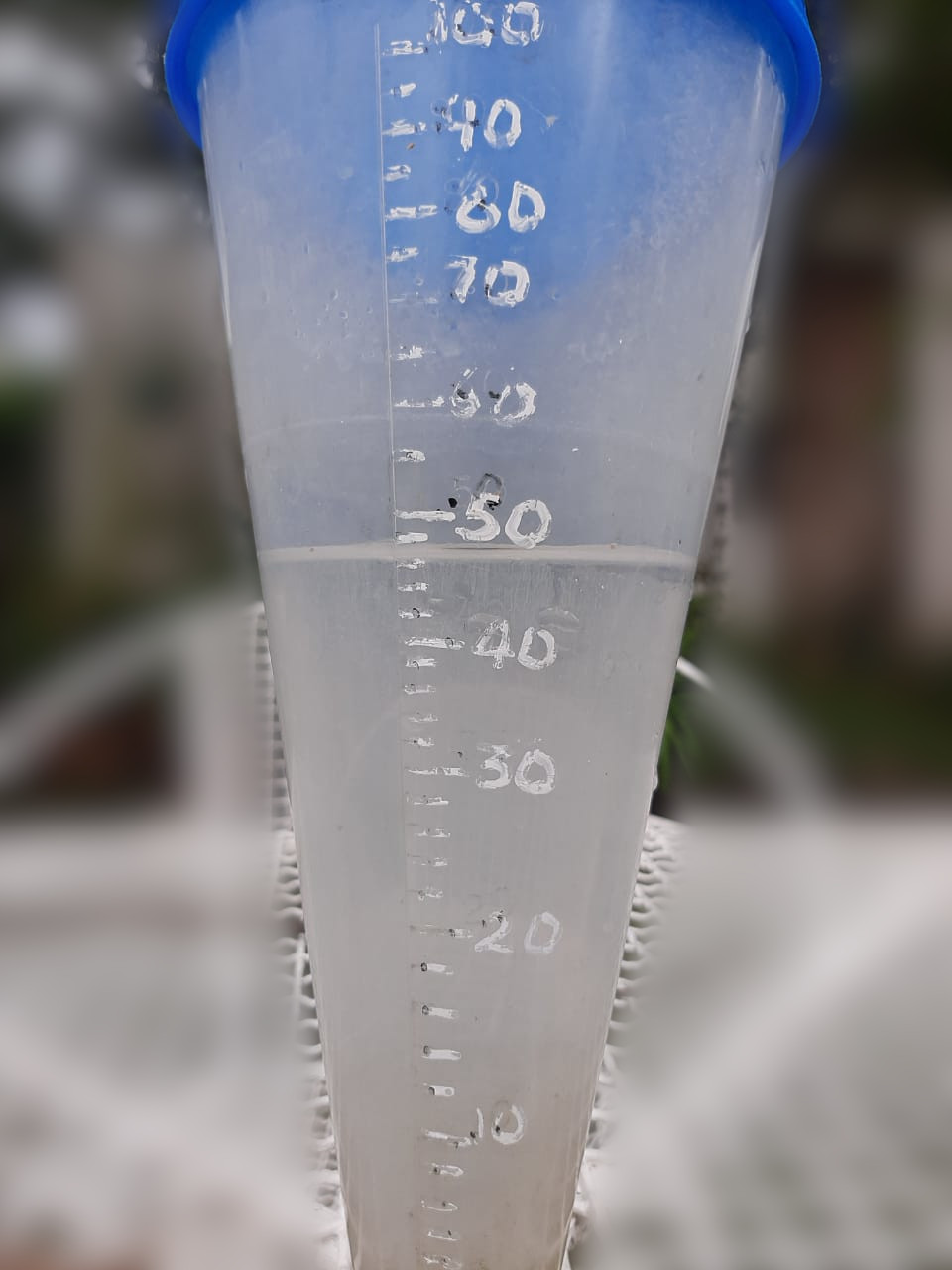
A resident in the Oatlands area measured 49mm in 35 minutes during a torrential downpour on Sunday 5 December and another 7.5mm Monday, bringing the total not far from 60mm.
DispatchLive reported on disaster in and around the city, with CBD businesses flooded as masses of litter washing down the town’s streams and gutters plugged stormwater drains and toppled trees blocked roads. Undertaker Ernie Cassels came to the rescue as the flood threatened to destroy homes at Sun City informal settlement.
The dams used to supply Makhanda west – Settlers and the smaller Howisonspoort dams – have been depleted by drought. They rely on rain falling in their catchment to fill via two rivers – the Kariega and the Palmiet rivers.
SmilingSouth asked farmers in those catchment areas what effect the recent rains have had on the water table.
“Fantastic rain!” said Richard Moss, of Mosslands west of Makhanda. “We had. 60mm in less than 60 minutes and the Kariega river is flowing for the first time since March 2015… which is beautiful.”
He said optimistically, “I think we can say the drought has broken, although we need a little more to fill the dams on the Kariega.”
Dale Howarth, Director of Pumba Game Reserve between Makhanda and Alicedale, was positive but more cautious.
“We got some lovely rain,” said Howarth. “Got 102mm for November and 90mm over the weekend, which got the water running. All our small stock dams are full and our two big lakes about half. The grass and veld is starting to recover nicely.”
But Howarth, who is the chairperson of the Central Albany Agricultural Association, said while good progress had been made, it was “a little bit early to say the drought is broken”.
The head of Rhodes University’s Geography Department Ian Meiklejohn also said it was too early to tell.
“We still have not reached average for this year,” Meiklejohn said.
“Also, the dams in the catchment area of Settlers’ Dam are not filling up. The rains were gorgeous, but limited (isolated). We need consistent rains for a while, before we can say the drought has been broken.
“In the meantime, I will simply celebrate the 40mm I measured in my garden for yesterday [Sunday] and 14mm for the day before.”
Dam levels on 7 December 2021, sourced by Makana Communication Officer Anele Mjekula, were Howieson’s Poort 75% and Settlers below 5%.
A resident in the Oatlands area measured 49mm in just over 35 minutes during a downpour in Makhanda on Sunday 5 December 2021. Photo suppliedHowieson’s Poort Dam on 26 November 2021. Photo: Sue MaclennanSettlers Dam on 26 November 2021. Photo: Sue Maclennan
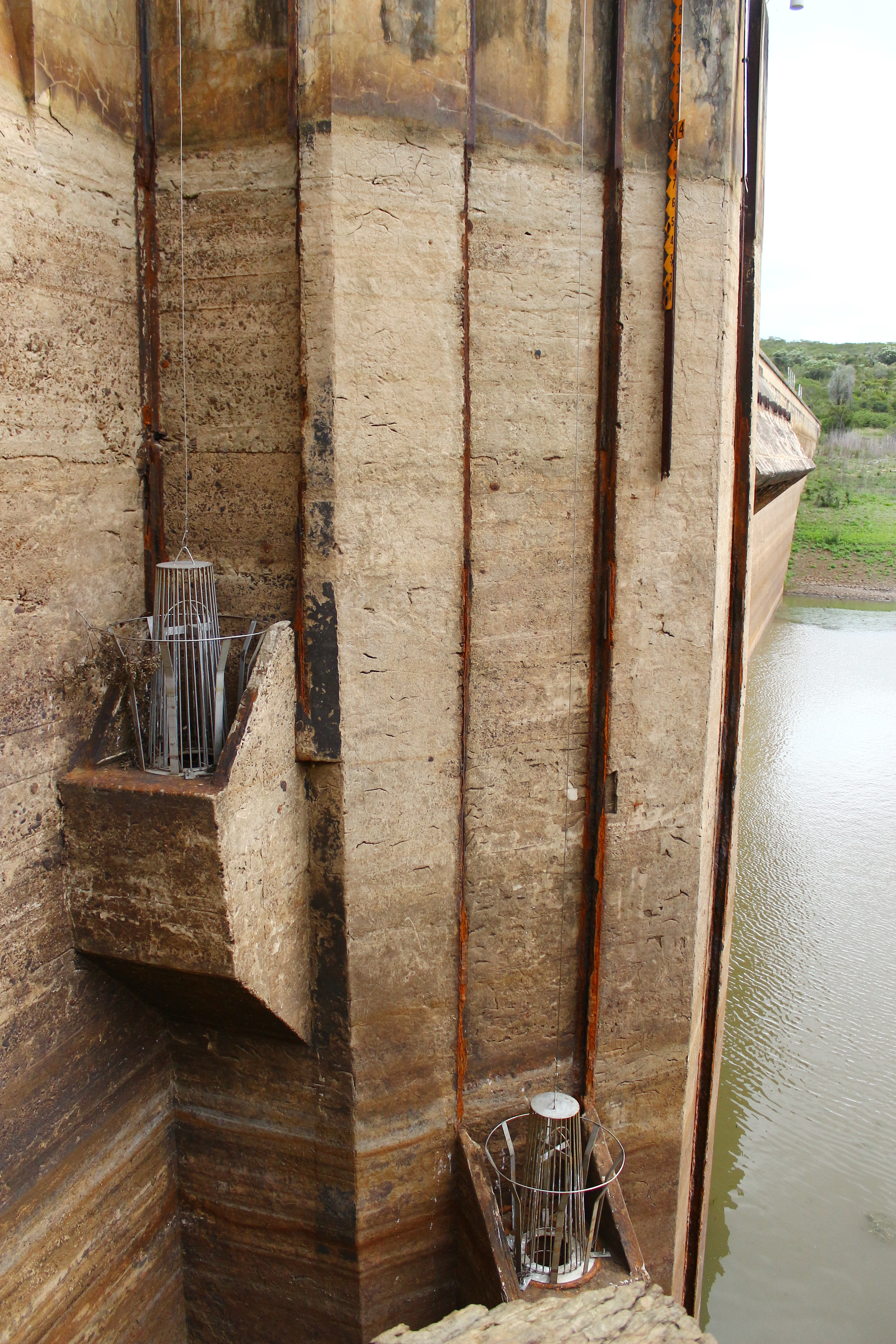
Settlers Dam on 6 December 2021. Photo: Lynda BrothertonHowieson’s Poort Dam on Monday 7 December. Photo: Lynda Brotherton
SmilingSouth update on Makhanda water supply – December 2021
Dam levelson 7 December 2021: Howieson’s Poort – 75%; Settlers – below 5% (courtesy Makana Communications Office)
Background
Makhanda’s main western supply dams, Settlers and Howieson’s Poort, have depleted during the past six years, dropping as low as 5% and 10% respectively. At those levels, water can’t be extracted. The much smaller Slaaikraal dams, Jamieson and Milner, which were used to supplement the main supply likewise emptied.
The much smaller Howieson’s Poort Dam fills up quickly but also empties quickly. At times it has filled up enough to supply the Waainek Water Treatment Works, but for the past year, for most of the time, all of Makhanda has been supplied by the much bigger James Kleynhans Water Treatment Works (JKWTW) east of Makhanda.
JKWTW is in turn supplied by Glen Melville Dam – a reservoir filled artificially (not by rain) by water released from the Orange River via the Fish River tunnel.
The average daily water demand in Makhanda is 18 megalitres a day and JKWTW produces just over half that amount, 10ML a day. In order to allow all the intermediate supply reservoirs to fill up and both high-and low-lying areas in the gravity fed system to receive water equitably, the entire supply is opened to consumers only every second day.
Old infrastructure (water supply pipes) results in a lot of water being lost through leaks. Makana Municipality appointed contractors to begin the process of replacing old asbestos pipes in certain areas. That work began earlier this year.
Previous reasons for delays in the upgrade
The James Kleynhans Water Treatment Works is being upgraded to double its production to 20 megalitres a day. An October 2019 Infrastructure Portfolio Committee report outlines the history and status at the time:
Bosch Projects was appointed in September 2013 as the service provider, starting with various scoping and technical reports. In March 2015, the project cost approved by DWS was R101 850 000. With Makana Municipality being placed under administration, Amatola Water was appointed as the implementing agent. Amatola in turn (re-) appointed Bosch in August 2015.
Because of DWS funding requirements, the project is split into four phases:
Phase 1 – Augmentation of JKWTW (R65.6 million)
Phase 2 – Augmentation of JKWTW (R102.7m)
Phase 3 – Upgrading/ refurbishment of existing pump station (R31.5m)
Phase 4 – Upgrading existing water treatment works (R31.5m)
The upgrade was delayed when the subcontractor appointed to complete Phase 1, Winwater, proved unequal to the task. Their contract was terminated and they left the site in June 2017. In line with Amatola’s procurement policy, the next in line was appointed to replace them and so Mamlambo Construction stepped in and began work in September 2017.
According to their contract, the work would be completed within 40 weeks – July 2018. But administrative delays pushed that date further back to March 2019.
But equipment had to be imported and Makana’s water crisis meant it wasn’t possible to shut down the plant for more than eight hours a week. And so the revised completion date became June 2019.
However, the Department of Trade and Industry cancelled the Phase 2 tender because, according to the report, “local content declaration was not allowed to be adjusted or amended post award”. So it was re-advertised in September 2019.
After it was awarded, the revised completion date was September 2021.
Parliament noticed
Earlier this year, Parliament’s Standing Committee on Public Accounts (SCOPA) grilled officials from the Department of Water and Sanitation, implementing agent Amatola Water and main contractor Bosch Civils on the process involved in awarding the upgrade contracts, and the delays and cost increases that resulted.
SCOPA questioned the fact that during the 10 years since the project was initiated, the budget had risen from an initial R68 million to R237.5 million. DWS explained that this was because the scope of the project had changed during that time.
What’s happening now?
Asked about the current status of the JKWTW upgrade, implementing agent Amatola Water said the new projected completion date is March 2022.
Nosisa Sogayise, Manager: Stakeholder and Communications, told SmilingSouth that Amatola Water had recently learnt that Mamlambo Construction was under new management. Responding to questions on Tuesday 7 December, Sogayise said Amatola had been giving the contractor assistance in its role as facilitator; however, this had not helped.
“The James Kleynhans project will not be finalized as per the planned date,” Sogayise said. “Amatola Water [has] learnt that the [company has] been sold and is currently under new management due to financial difficulties experienced by the contractor.
“The contractor had difficulties in procuring material for the project and to remunerate employees,” Sogayise said.
Makana referred queries about the project to Amatola Water, who referred specific questions about the contractor to Mamlambo Construction. That company in turn referred questions back to Makana. And so SmilingSouth has not yet been able to confirm the status of the contractor from Mamlambo themselves.
And what if it rains enough to fill the dams west of Makhanda?
The DA reported on a recent oversight visit to the Waainek Water Treatment Works, saying that the building was unsecured and that pumps and motors were missing.
The closing time for parties to submit their candidate lists and election deposits for the upcoming local government elections has been extended by four hours, to 9pm today. However, the Electoral Commission (IEC) emphasises that deadline day – 23 August 2021 – remains the same. Here is their statement issued today 23 August 2021:
Political parties and independent candidates intending to contest the Local Government Elections scheduled for 27 October 2021 have until 21H00 today to submit their nominations and prescribed election deposits.
In terms of the election timetable, the cut-off date is Monday, 23 August 2021. The Electoral Commission has extended the time to 21h00.
Prescribed election deposits which are also due on 23 August 2021 are as follows:
(a) R3 500 (three thousand five hundred rand) in respect of an election in a metropolitan municipality; (b) R2 000 (two thousand rand) in respect of an election in a local municipality with wards; (c) R1 000 (one thousand rand) in respect of an election in a district municipality; and (d) R1 000 (one thousand rand) in respect of an election in a single ward for independent candidates and political parties not contesting for PR election in that municipality.
Failure to make payment for election deposits on 23 August 2021 will result in automatic disqualification of the party or independent candidate affected. Failure to pay deposits on due date is incapable of being remedied through a non-compliance procedure.
The Commission will refund to a party any deposit paid, if the party is allocated at least a seat in the municipal council it is contesting. Similarly, an independent candidate who receives at least 10% of the total number of votes cast in the ward election will have the deposit refunded.
Only registered political parties may contest elections of municipal councils by way of party lists. Currently, there are 480 registered parties of which 298 registered on a national level which entitles the affected parties to contest any municipal council in the country. The balance of 182 parties are registered at a district or metropolitan level. This level of registration allows the affected parties to contest any local council within the district, whilst the metropolitan level allows for contestation within the relevant metropolitan municipality of registration.
To date, 97 political parties and 353 independent candidates have either captured their nominations or have submitted nominations.
Parties and independent candidates may submit their documents online at http://www.elections.org.za or visit a designated local office of the Commission. The list of the designated offices is available on the website.
The Electoral Commission will have until Friday, 27 August to notify political parties and independent candidates of any non-compliance in respect of outstanding documents.
Thereafter, the Electoral Commission will have until 31 August to notify parties of any candidates appearing on multiple party lists. The affected parties will have until 17h00 on 2 September decide whether to remove such candidate and order their lists.
The final list of candidates will be certified and published on 7 September 2021.




 SmilingSouth