By Sue Maclennan
“The government of Putin is not Mikhail Gorbachev’s government that helped us.”
Archbishop Nkosinathi Ngesi, of the Ethiopian Episcopal Church, has put his weight behind growing outrage at the war in Ukraine that has in the past two weeks seen more than 100 civilian deaths reported, including 13 children.
Ngesi, who is a former military chaplain, said, “This Russia is not the government that helped us in our fight against apartheid, when we sent our soldiers to be trained there.
“This Russia is there for nuclear resources, and for Ukraine’s oil and gas.
“Our government must call on Putin’s government to withdraw his forces, and stop killing the people of Ukraine,” Ngesi said. “Our government is wrong to keep quiet and we are disappointed that they abstained in the United Nations vote calling on Russia to withdraw.”
On Wednesday, 141 of the United Nations’ 193 members voted in favour of a resolution demanding that Russia “immediately, completely and unconditionally withdraw all of its military forces from the territory of Ukraine within its internationally recognised borders”.
The voting concluded a special emergency session of the General Assembly that began on Monday.
Five countries – Belarus, the Democratic People’s Republic of Korea (“North Korea”) Eritrea, Russia and Syria – voted against it. South Africa was one of 35 that abstained.
“Our government did not read the mood of South Africans when they did this,” Ngesi said. “They did not represent us when they abstained.”
On Tuesday, the South African Council of Churches (SACC) issued a statement supporting proposed mediation by Pope Francis “for lasting peace and security between Russia and Ukraine”.
The SACC, in its statement, urged Christians to observe the Ash Wednesday fast and “take time praying for peace and the success of the efforts for an unconditional ceasefire, earnest negotiations for guarantees of lasting peace and security for both Ukraine and Russia, for the wellbeing and prosperity of God’s people in both countries”.
Archbishop Ngesi said he supported the SACC’s statement, but went further.
“The South African government must call on Putin to withdraw his forces and stop killing the people of Ukraine. Our government is wrong in keeping quiet because at the end of the day, the people of Ukraine will judge us by our response.”
On Friday, International Relations and Cooperation Minister Naledi Pandor, said, “South Africa is continuing to encourage all the parties, through quiet diplomacy, within all relevant international mechanisms, such as the United Nations (UN) including Brics, to strengthen all diplomatic efforts to avoid an escalation of tensions, and work towards an inclusive, sustainable and peaceful solution based on cooperation and dialogue.”
Pandor said this, IOL reported, in reply to a written question in Parliament from the IFP’s Mkhuleko Hlengwa.
Archbishop Ngesi is a member of a group calling themselves the Makhanda Legends which protested outside the Makhanda City Hall against alleged corruption in Makana Municipality in 2020. They aligned themselves with the SACC’s 2020 anti-corruption campaign. Ngesi condemned malfeasance in municipalities across the province.
The Ethiopian Episcopal Church had its origins in 1899 under theologian James Mata Dwane. Today it has 87 branches throughout South Africa, in every province, with a membership of around 2 million. An affiliate of the South African Council of Churches, its head office is in Makhanda and Archbishop Nkosinathi Ngesi is its leader.
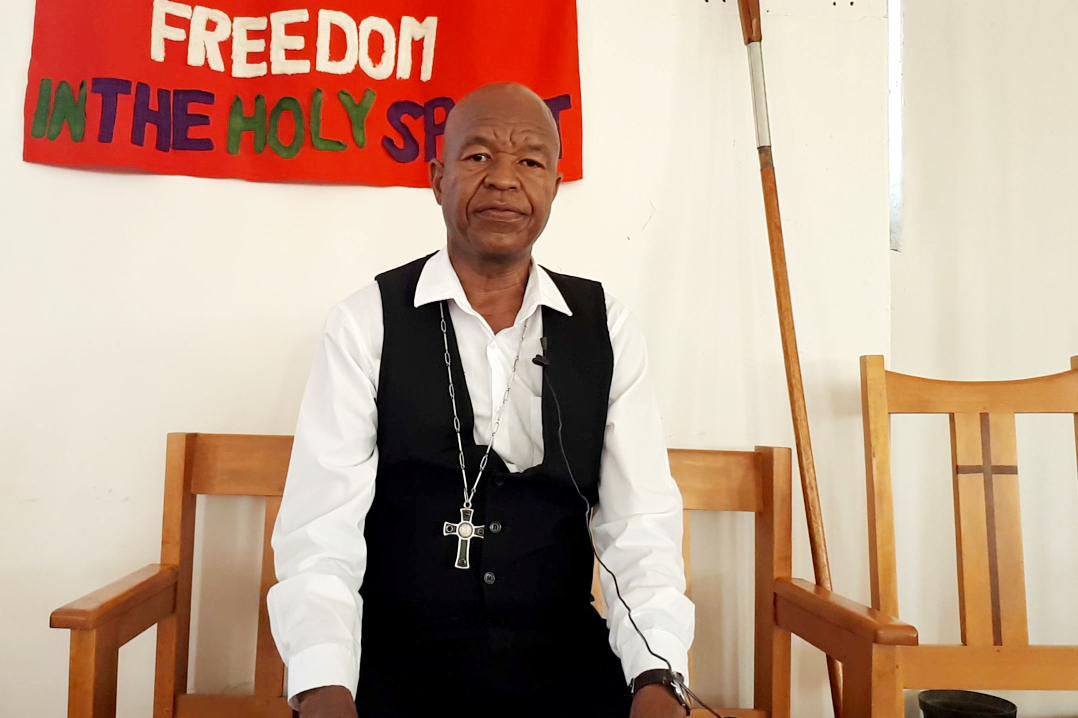
Archbishop Nkosinathi Ngesi of the Ethiopian Episcopal Church has criticised the South African government’s response to the crisis in Ukraine. Photo: Sue Maclennan
 SmilingSouth