Alarming reports, some of them informed by experienced technical sources, paint a picture of an imminent health and humanitarian disaster, with broken pumps, a shortage of treatment chemicals, an official’s removal of a crucial monitoring system and no public access to up-to-date water quality testing results. Makana has slammed some of the claims as ill-informed and says they could create unnecessary panic among the public. SmilingSouth independently asked expert sources to help judge how concerned we should be.
By Sue Maclennan
It sent shockwaves across South Africa when in 2019, the Gift of the Givers was welcomed by desperate Makhanda residents during a weeks-long water outage. Investigations by civil society activists and a councillor suggest the town’s 86 000-odd residents could be at risk of a water crisis at least as bad as any the town has survived in the past decade.
Monitoring by the DA and the Makana Residents Association has been reported on those organisations’ platforms during the past few weeks. The latest reports on Friday 18 February and Monday 21 February from councillor Geoff Embling and the Makana Residents Association say that:
- Of seven pumps that should be rotating at Makhanda’s two water treatment facilities, only one is properly operational;
- Both were set to run out of treatment chemicals by early next week (the water manager says these have arrived – please note the update on this below);
- An official has had crucial water-level monitoring equipment removed from two stations;
- With current water testing results yet to be made available, the community is in the dark about safety compliance.
How Makhanda’s water works
Makhanda has two water systems. Howieson’s Poort and Settlers dams depend on rainfall in catchments west of town. They serve the CBD and suburbs in west Makhanda via the Howieson’s Poort pump station and Waainek water treatment works.
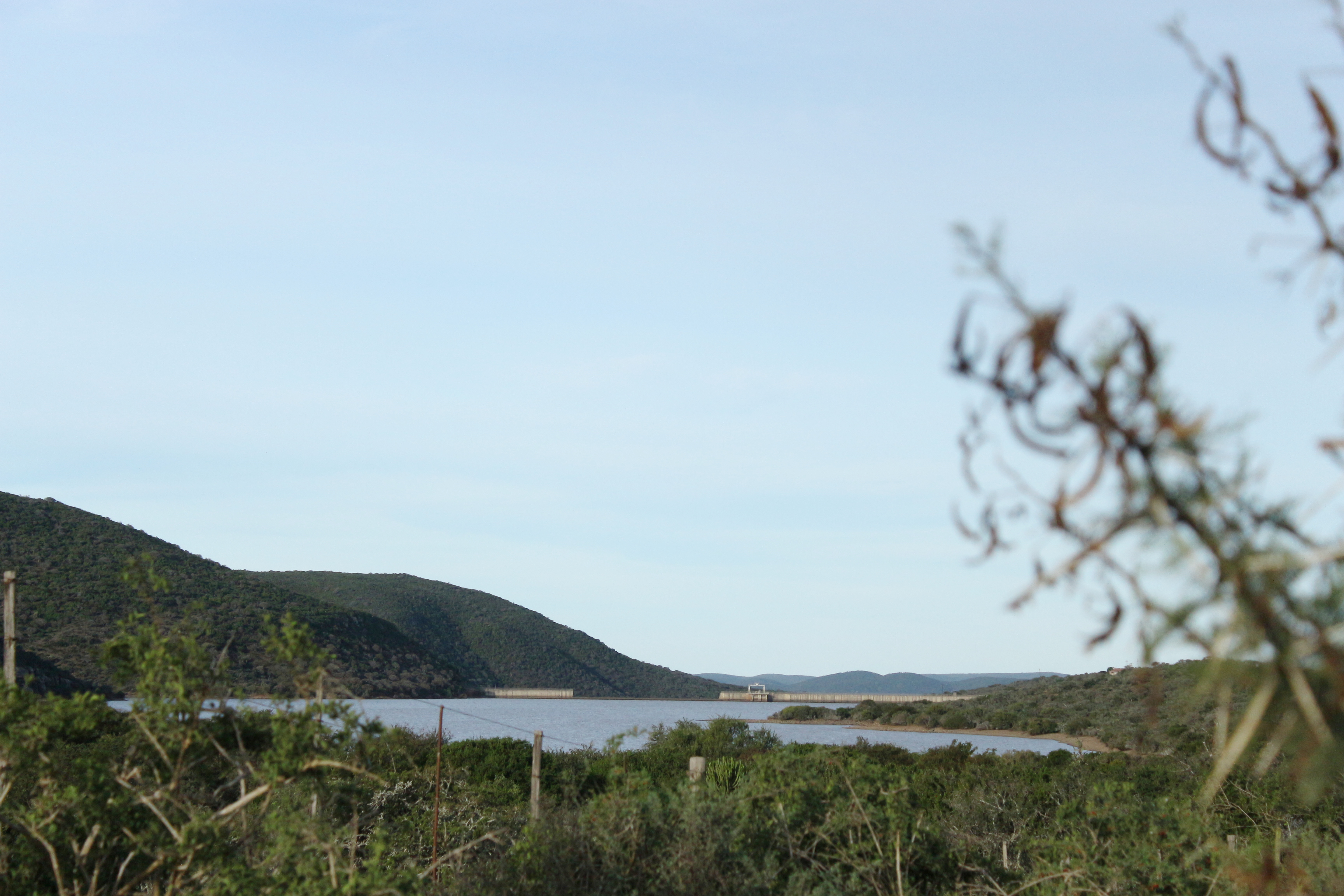
The Orange-Fish River scheme feeds Glen Melville Dam. Pumping from there, the James Kleynhans Water Treatment works and pump station serve the east side of Makhanda, including its townships.
What the monitoring reports said
Councillor Geoff Embling’s 18 February report warned that there was only one pump in operation in the Howieson’s Poort pump station – an observation he and fellow councillors had already made in December 2021.
“It was alleged that one pump burned out due to the operator running the pump whilst the inlet valve was closed,” Embling wrote. The second pump’s impellor had broken when it was run during low water levels.
The remaining pump was in poor working condition, leaking water, Embling wrote. His sources estimated that Waainek currently receives about 70% of the 8 megalitres a day it requires from Howieson’s Poort pump station.
“If the remaining pump was to break, the Western half of town would be without any water at all…” Embling wrote on 18 February.
A transfer pipeline carrying water from James Kleynhans to west Makhanda should ensure the whole town receives water, even during drought. But it’s broken and hard-to-source parts are delaying its repair.
There were also fears about the integrity of the James Kleynhans system. Embling, informed by an experienced engineer, said James Kleynhans required four pumps, or at least three in rotation, to prevent overloading. Currently there were only two.
“Out of the two remaining pumps at James Kleynhans, one… keeps tripping and must be reset, so the pump station is largely reliant on one pump to deliver water from James Kleynhans to the eastern side of town,” Embling said. “It is disturbing that both… water supplies are basically running on one cylinder… it seems as if the two ‘lifelines’ to [Makhanda] are hanging by a thread.”
More than 86 000 residents would be affected should both fail at the same time, Embling said.
Embling described an incident at Waainek in December 2021.
“Poor flocculation and treatment [resulted in] in dirty water… [and] approximately 24 megalitres of treated water being released down the hill at Waainek. The wasted water had allegedly been treated with just over a ton of chemicals.”
Embling said a report in the recent Finance portfolio committee said Makana’s supplier of water treatment chemicals had been paid close to R200 000, but had not delivered. The municipality had issued them with a letter of non-compliance and (at the time) there were less than two weeks’ worth of treatment chemicals left.
“The public needs to be informed about the situation,” Embling said.
The concern came as the Chris Hani District Municipality has become the latest public entity to advise residents to boil tap water due to poor quality. Nelson Mandela Bay metro has now declared their water safe to drink following diarrhoea and vomiting outbreaks and the death of a child allegedly linked to dirty water. Buffalo City Metro Municipality’s boil water advisory still maintains.
Four years ago, in May 2018, Makana was in national headlines as levels of e.coli in the supply far exceeded SANS safety standards at several sites across the municipality.
A 21 February letter from the Makana Residents Association to its members echoed Embling’s warnings and said it was a concern that the only person with access to the municipality’s high-tech monitoring system, SCADA, was the municipality’s water manager. Two other monitoring terminals had been removed from their stations at a local engineering company, and Rhodes University.
Continuing outages
Meanwhile, on the ground, residents and businesses continue to experience outages – in some cases for longer than two weeks at a time. The regime of providing water on alternate days is intended to allow all the town’s reservoirs to fill, so there can be equitable distribution from the gravity fed system. However, residents have frequently reported no water, or an early cut-off on days when they are due to have water.
A break in the transfer line from James Kleynhans and the Worcester Street engineering nightmare, along with numerous pressure-related pipe breaks across the town, have brought about several outages since the beginning of the year, in some areas as long as two weeks at a time. Most recently, a large release of water for downrtream users into the Fish River system that serves James Kleynhans resulted in high turbidity there, with challenges for treatment and therefore supply.
Some residents in Fitzroy Street have had no water at all in their taps for over two weeks.
“I can’t remember the exact date our water went out,” one resident told SmilingSouth. “But it’s been over two weeks now that we’ve had no water. “Our tanks are almost dry now and there is no rain.”
Fitzroy Street is the site of a project to replace old asbestos pipes. Completion of the project was hampered by the theft two weeks ago of several (metal) connecting valves.
On neighbourhood WhatsApp groups across the town, residents and business owners frequently report taps running dry early on “water on” days.
By Friday 25 February, residents in Emacangcini near JD Dlephu Stadium – served by the James Kleynhans system – reported having had no water for three days.
Makana’s Communications team posts updates daily. These sometimes include warnings of additional outages for maintenance or repairs; however, some outages aren’t explained and residents continue to vent their frustration at this on social media.
‘Misinformed perspectives’
Responding to questions based on the reports, Makana Municipality has hit back at the monitoring visits.
“Unauthorised visits without relevant escorts are not allowed, as they tend to provide misinformed perspectives,” the municipality said via its communications department.
The response from Makana Municipality to this reporter’s questions is included in full below. Some of the responses raise further questions. For example, Makana says of the Howieson’s Poort Pump Station that the municipality has submitted business plans to potential funders for its refurbishment, including the purchase of a full pumpset.
Amatola Water, which managed Makana’s bulk water supply from 2013 to 2017, completely refurbished the Howieson’s Poort pump station at a cost of R2 116 804.77. This included repairing motors 1 and 2 at Howieson’s Poort pump station; completely refurbishing a third pump; upgrading the pump control panels and installing instrument control devices, among other upgrades and repairs. This information is contained in the organisation’s close-out reports. In presentations to the municipality and residents at the time (2017), as well as earlier interviews with this reporter, Amatola Water explained that new pump and motor were specifically built to ensure that there was sufficient spare capacity to minimise the risk if there was catastrophic failure of pump sets 1 or 2. This was done due to the very long lead times to have those big motors and pumps repaired (around six months).
At the time, it cost around R500 000 to refurbish one of the Howieson’s Poort pumps. A single impeller blade took a week to be precision-engineered by the supplier.
It was for these reasons that protection mechanisms were built into a brand new control panel at the facility. A Programmable Logic Controller, it’s designed to receive data from the operating components (the pump systems) and in turn send operating instructions (such as to shut down the pump if it’s overheating).
Makana’s responses (as of 22 February at 8pm)
Water treatment chemicals
Makana Municipality (MM): The available chemical is sufficient to take us to Thursday, 24/02, when the next batch is delivered. There is a general shortage of water treatment chemicals, due to scarcity of raw materials nationwide (see http://ws.dwa.gov.za/IRIS/notice.aspx), and this is not unique to Makana Municipality.
UPDATE ON 25 FEBRUARY 2022
Makana’s Water Manager Gubevu Maduna Friday morning 25 February told this reporter that water treatment chemicals for the two waterworks had been delivered on Wednesday 23 February – a day earlier than scheduled. “We also have backup stocks, so it was not going to be a problem,” he said.
‘Burnt out’ pump at Howieson’s Poort
MM: The matter was reported and investigated but could not be proven. However, the municipality will gladly accept any further information that the community can assist with.
Second broken pump at Howieson’s Poort
MM: When the level of the dam is low, water quality deteriorates… high amounts of suspended solids [cause] excessive throttling on the sleeves… the impellers get stuck in the neck ring…”
NOTE FROM A SOURCE WITH KNOWLEDGE OF THE SYSTEM:
For either of these catastrophic events to occur, either the PLC was not working, or it was bypassed. The software is designed to make the pumps shut down before an event such as cavitation or overheating.
Remaining pump at Howieson’s Poort
MM: The remaining Pump at H/Poort is designed to pump 131l/s, translating to 11,3Ml/day, which is more than enough for the design capacity of Waainek Water Treatment Works, hence the excess amount of water pumped, but not treated is stored in the lei dams. The pump was repaired in June 2021… [it] is currently working and not in need of repairs. The pump is designed to have a circulation of cooling water and wet gland packings, for its normal operations. This may be viewed as a leak, from a layman’s point of view, hence unauthorised visits without relevant escorts are not allowed, as they tend to provide misinformed perspectives.
NOTE FROM EXPERIENCED ENGINEERS OUTSIDE THE MUNICIPALITY
Source 1: The response from muni is correct in that pumps have packing glands (kind of bearings) that are kept moist with water from the pump – it is not usually a lot of water (a trickle) so if it appeared to be a leak there could be a problem.
Unfortunately the municipality has responded according to some of the details and not addressed the most serious issues: Howieson’s Poort has only one pump which has to operate 24/7 in order to supply water for west of town while the transfer pipe is damaged. For an official to have the opinion that only one pump is necessary at Howieson’s is indicative of bad practice being taken as acceptable.
Source 2: Yes it’s correct that water pipes fixed to each pumpset are meant to drip at a certain rate to cool down the bearings. Howiesons Poort requires three pumps: one duty pump, one standby pump and one cold standby pump. These must be alternated to allow for maintenance.
- These sources, with whom this reporter communicated directly, asked to remain anonymous.
James Kleynhans pumps
MM: JKWTW has a design capacity of 10Ml/day and the Treatment works delivers and pumps from the Treatment Works to the Reservoirs an average 11.5Ml/day which is only achievable with 2 working Pumps. So, it is incorrect to claim that only 1 pump in JKWTW is effectively working. The pumps are designed to cut off when the clear water well is at minimum level, which may be viewed as tripping by a non-expert. This is a protection mechanism that is designed to minimise catastrophic damage that could occur should the pump run without enough water in the suction head. Once again, this is an ill-informed view, which creates unnecessary panic [among] the public.
NOTE FROM AN EXPERIENCED ENGINEER OUTSIDE THE MUNICIPALITY
If the pumps are stopping due to an empty intake tank that is normal – but if the pumps were tripping (due to a fault such as overheating) that is a different matter. JKWTW with only two pumps is also operating at full capacity without provision for standby and maintenance. This is bad and very risky procedure. There is a reason that these pump stations have been designed by engineers with respectively three and four pumpsets. Emphasis should be on these bigger issues without the Municipality answering only some of the technicalities.
- This source, with whom this reporter communicated directly, asked to remain anonymous.
What is the plan if the single operational pump at one or other (or both) treatment plant(s) breaks down?
MM: JKWTW: All 4 pumps are at the plant… However, what is missing, are the 2 motors, to have 4 complete pumpsets. 3 motors went for repairs and are ready to be delivered and installed.
MM: HOWIESON’S POORT: The 2 pumps went for strip and quote, however, due to the associated costs, it was viewed uneconomical to repair than replacing. The Municipality is in constant talks with the Service Providers, to establish various options that could be most economically viable and beneficial to the Municipality. On the other hand, the municipality had submitted Business Plans to potential funders for the refurbishment of the pumpstation which also includes a purchasing of a full pumpset.
24 million litres of treated water wasted in December 2021
MM: The total coagulant used for the month of December was 900 litres (1035kg) to treat 69.7ML. 60% of this water was further treated with [disinfectant] before [entering] the reservoir. The remaining 40% had to be released into the stream that flows back to Howieson’s Poort Dam, as it was not fit for human consumption. This had nothing to do with the incorrect methods, but rather a situation resulting from an abnormal raw water turbidity, for the available coagulant normally used at Waainek WTW. The plant is usually operated with a low-turbidity range coagulant… raw water turbidity is normally below 40NTU. As a result of the flash floods in December, the turbidity of the raw water spiked up to more than 1000NTU.
SCADA system monitoring panels removed
MM: The SCADA is an operational system that helps the operators to monitor and manage the water value chain. The current operator of the Makana Water System is Makana Water Department which is managed by Mr Gubevu Maduna… This is a vulnerable system that requires restricted access for control purposes and accountability, hence it cannot be co-managed and accessible to everyone.
Water quality testing results
MM: Samples were taken and the results are available, however cannot without being uploaded on DWS’s IRIS system… Once uploaded, they will be made available to you.
UPDATE ON FRIDAY 25 February 25, 2022
Water Manager Gubevu Maduna said the results had been uploaded on IRIS and were available via the Infrastructure Director. This reporter has requested a copy from the Director.
UPDATE: THESE WERE RECEIVED ON 1 MARCH 2022 (SEE BELOW)


 SmilingSouth